Maximizing Dealer Profit with Multi-Vehicle Transport Strategies
Maximizing Dealer Profit with Multi-Vehicle Transport Strategies
Multi-vehicle transport strategies are becoming one of the most effective ways dealers protect margins while maintaining predictable inventory flow in 2026 and beyond.
As vehicle acquisition costs fluctuate, floorplan interest tightens margins, and consumer demand shifts toward faster availability, dealership profitability increasingly depends on logistics efficiency per unit — not just sales performance.
For high-volume dealer groups, fleet buyers, and OEM-aligned retail networks, consolidated vehicle transport is no longer optional. It is a financial lever.
This guide breaks down how structured multi-vehicle transport models directly improve dealer profit performance.
Why Transport Strategy Impacts Dealer Margin
Every shipped vehicle carries:
- Linehaul transport cost
- Insurance exposure
- Handling risk
- Dwell time impact
- Floorplan interest accrual
- Sales delay risk
When vehicles are shipped individually or inconsistently, cost per unit rises and scheduling becomes unpredictable.
Multi-vehicle consolidation reduces:
- Per-unit shipping expense
- Empty mile inefficiencies
- Administrative handling
- Partial load premiums
Transport strategy directly affects:
| Profit Driver | Logistics Impact |
| Gross margin | Per-unit freight cost |
| Inventory turnover | Delivery predictability |
| Floorplan interest | Reduced dwell time |
| CSI scores | Damage prevention & ETA accuracy |
| Cash flow | Faster lot availability |
Dealers optimizing freight are not cutting corners — they are structuring distribution.
The Financial Advantage of Multi-Vehicle Loads
1. Lower Cost Per Unit
Car carriers operate most efficiently when fully loaded. A 7- to 9-car carrier distributing multiple units along optimized lanes reduces cost allocation per VIN.
Instead of paying premium rates for single units:
- Cost is distributed across multiple vehicles
- Fuel efficiency improves
- Route clustering reduces deadhead miles
For dealer groups operating across states like Texas, California, Arizona, Georgia, and Michigan, clustered shipments significantly outperform fragmented dispatching.
2. Reduced Floorplan Interest Exposure
Inventory sitting in transit is capital tied up.
By consolidating vehicles into predictable delivery waves, dealers:
- Reduce staggered arrival delays
- Improve lot readiness planning
- Shorten time-to-sale windows
Even a 2-3 day acceleration in lot availability can materially reduce monthly interest costs for high-volume stores.
3. Improved Inventory Planning
Multi-vehicle strategies align with:
- Seasonal demand forecasting
- Promotional campaign launches
- Fleet delivery schedules
- Trade cycle management
Instead of reactive shipping, dealers shift to scheduled freight blocks — improving internal coordination between acquisition, sales, and finance departments.
Open vs Enclosed Multi-Vehicle Transport
Most dealer inventory moves via open multi-vehicle carriers. However, enclosed multi-vehicle transport is increasing in:
- High-value EV distribution
- Performance vehicles
- Specialty trims
- Prototype or early release models
Comparison Overview:
| Factor | Open Multi-Vehicle | Enclosed Multi-Vehicle |
| Cost | Lower | Higher |
| Exposure | Weather exposure | Protected |
| Capacity | 7–9 vehicles | 2–6 vehicles |
| Best For | Standard retail inventory | Premium & specialty units |
Dealers should align transport method with unit value and risk profile — not default assumptions.
Route Optimization for Dealer Groups
Dealer groups with multiple rooftops gain additional leverage.
Strategic advantages include:
- Cross-location consolidation
- Hub-and-spoke routing
- Backhaul coordination
- Inter-dealer transfers in single loads
Example:
A dealer group in Texas receiving units from Arizona and Georgia can structure:
- Plant → Regional hub
- Consolidated carrier → Multiple rooftops
- Reverse backhaul for trade-ins or transfers
This reduces:
- Empty return miles
- Isolated dispatch fees
- Fragmented scheduling
Multi-Vehicle Transport for Auctions & Fleet Acquisitions
Auction purchases and fleet acquisitions often involve bulk volume.
Instead of dispatching per-unit pickups:
- Batch releases
- Structured load planning
- Dedicated carrier assignments
Benefits include:
- Priority scheduling
- Damage reduction through standardized loading
- Faster reconditioning pipeline
For fleet buyers, consolidated transport also simplifies:
- Title documentation coordination
- VIN tracking
- Arrival staging
Damage Reduction Through Structured Loading
Fragmented shipments increase touchpoints.
Multi-vehicle structured loading provides:
- Controlled yard loading environments
- Experienced carrier crews
- VIN-level inspection documentation
- Digital condition reporting
Consistency reduces:
- Minor cosmetic damage claims
- Insurance disputes
- Re-delivery coordination
Profitability improves not only through cost reduction — but through damage prevention.
Visibility & VIN-Level Tracking
Modern dealer logistics requires transparency.
Multi-vehicle transport partners should provide:
- Real-time GPS tracking
- VIN-specific status updates
- Digital BOL access
- Exception alerts
- Predictive ETAs
For dealer groups managing multiple locations, centralized reporting reduces administrative overhead.
Expedited Multi-Vehicle Options
Standard consolidation works for planned inventory. However, scenarios requiring expedited multi-vehicle transport include:
- Recall campaigns
- High-demand trim restocking
- Market response adjustments
- Manufacturer incentives
Dedicated capacity can move 3–6 vehicles quickly while maintaining cost efficiency relative to single expedited units.
Risk Management Considerations
When evaluating multi-vehicle transport partners, dealers should assess:
✔ Cargo insurance limits
✔ Claims resolution process
✔ Driver experience
✔ Load securement protocols
✔ Weather contingency planning
✔ Peak season capacity availability
Rate alone does not determine profitability.
Risk exposure determines long-term cost control.
Sustainability & Reporting
Dealer groups increasingly track:
- Fuel efficiency
- Carbon impact
- Route optimization
- Idle reduction
Consolidated loads reduce per-unit emissions — supporting corporate sustainability reporting initiatives.
The CRC Transport Multi-Vehicle Model
CRC Transport structures dealer multi-vehicle distribution around three operational layers:
1. Volume Assessment
- Weekly / monthly unit forecasting
- Lane clustering analysis
- Equipment allocation planning
2. Structured Dispatch
- Consolidated load optimization
- Cross-state coordination
- Real-time monitoring
- Proactive communication
3. Post-Delivery Reporting
- Digital documentation
- VIN-level delivery confirmation
- Claims transparency
- Performance KPI tracking
This model supports dealer groups operating across major U.S. automotive corridors.
FAQ: Multi-Vehicle Dealer Transport
Is multi-vehicle transport always cheaper?
Per unit — almost always, when volume and routing are properly structured.
Does consolidation delay delivery?
Not when loads are scheduled strategically around acquisition timelines.
Can high-value vehicles move in multi-vehicle enclosed carriers?
Yes. Smaller enclosed carriers support grouped premium vehicle movement.
How many vehicles justify consolidation?
Typically 3+ units per lane begin generating measurable cost efficiency.
Does consolidation increase damage risk?
Proper structured loading reduces handling inconsistencies and often lowers claims.
Final Perspective
Dealer profitability in 2026 is increasingly operational.
Sales performance matters — but logistics precision determines how much of that gross margin is retained.
Multi-vehicle transport strategies reduce per-unit cost, accelerate inventory readiness, improve predictability, and reduce operational risk.
For dealer groups seeking scalable, margin-protecting logistics solutions, consolidation is not simply about efficiency.
It is about competitive advantage.
Reliable Experts in Automotive Transportation
Have any questions or wish to Schedule a pickup today?
Related Posts
Leveraging Data Analytics to Optimize Automotive Supply Chains
In 2026 and beyond, OEMs and high-volume dealer groups are no longer relying on historical averages or manual reporting to guide logistics decisions. Instead, they are leveraging real-time performance data, predictive modeling, and VIN-level tracking to reduce cost, mitigate risk, and accelerate inventory flow.
Salutations! I am Green Onyx, your robotic CRC Transport LLC ambassador
From time to time, my transmissions will land in your feed, illuminating the extraordinary technological advancements that are revolutionizing your transportation systems.
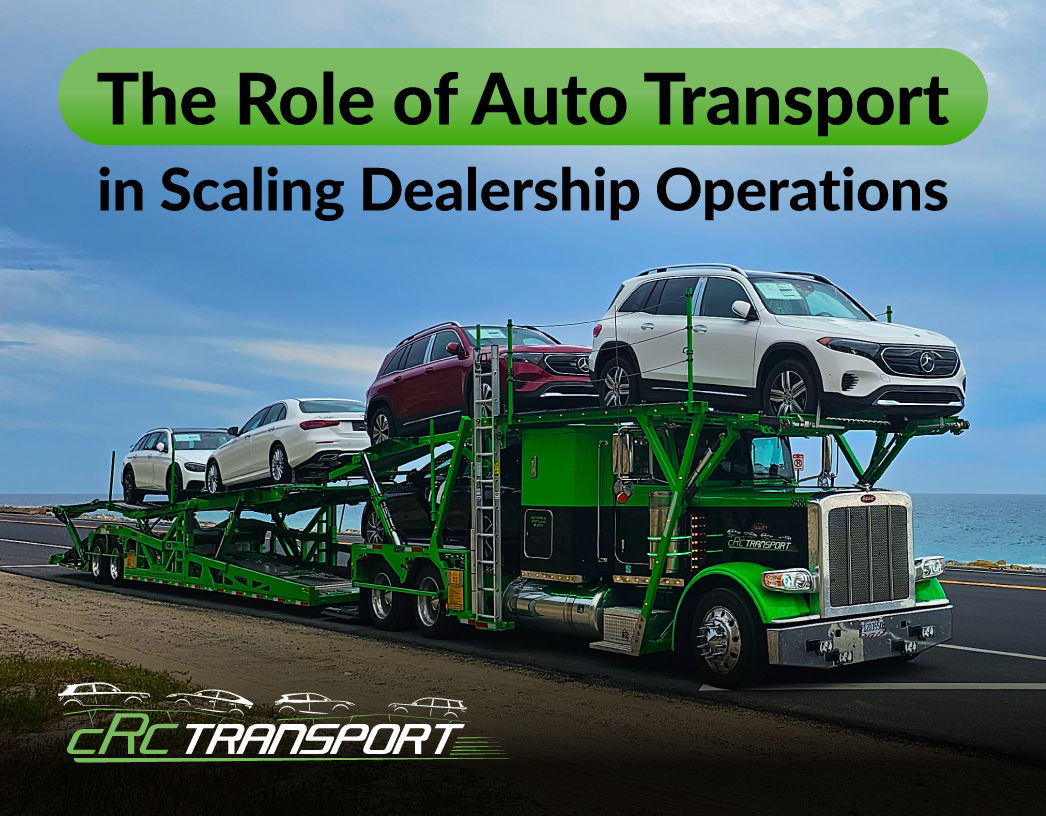
The Role of Auto Transport in Scaling Dealership Operations
For car dealerships, efficiency is paramount when it comes to inventory management and customer service. As dealerships grow and expand, they need reliable and scalable solutions to handle the logistics of vehicle movement. Auto transport services play a crucial role in scaling dealership operations, providing the foundation for smooth and cost-effective vehicle delivery.

Merry Christmas and a Happy New Year filled with meaningful journeys and cherished milestones!
Every journey has a story, and every story carries a lesson.
This Christmas, CRC Transport celebrates the moments of reflection that help us rediscover what truly matters…
